
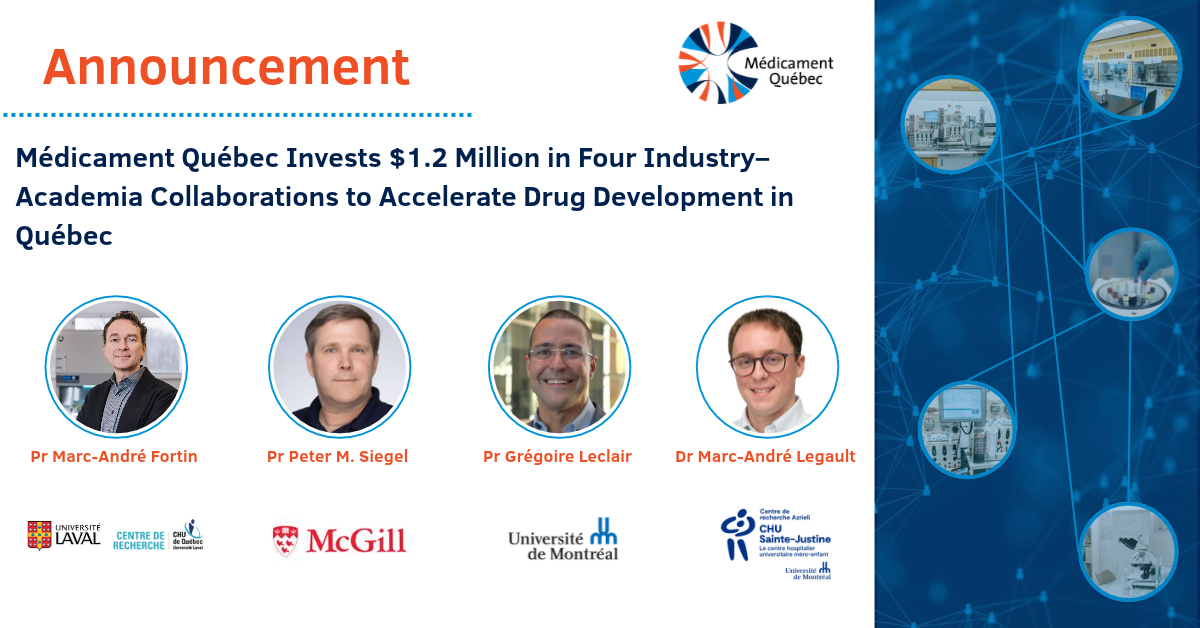
Four Industry–Academia Collaborations to Accelerate Drug and Vaccine Development in Québec
October 20, 2026 – News from Medicament Québec
As part of its Industrial Access to Academic Platforms program, Médicament Québec is investing $1.2 million to support four collaborative research projects bringing together academic researchers and Québec-based companies. Including contributions from industry partners, these projects represent a total investment of $2.5 million.
Supported by the Government of Québec, these initiatives aim to address concrete industry needs by facilitating access to academic expertise, equipment, and infrastructure. Beyond the individual projects, they will contribute to the development of sustainable, high-impact capabilities, the enhanced use of research infrastructure, and stronger collaborations between academia and industry, benefiting Québec’s drug and vaccine ecosystem.
The funded activities are:
- Prof. Marc-André Fortin (CHU de Québec Research Centre, Université Laval), Aramis Biotechnologies Inc., and Feldan Therapeutics: Accelerating the generation of reliable scientific data in nanomedicine through an advanced microscopy service for Québec companies in the vaccine and pharmaceutical sectors.
- Prof. Peter M. Siegel (Goodman Cancer Institute, McGill University) and 9Bio Therapeutiques: An integrated ADC development platform connecting antibody engineering, critical quality attributes, and translational performance for Québec’s biotechnology ecosystem.
- Prof. Grégoire Leclair (Université de Montréal) and Medisca Pharmaceutique Inc.: Toward sustainable pharmaceutical autonomy: Structuring and standardizing pharmaceutical compounding in Québec.
- Prof. Marc-André Legault (CHU Sainte-Justine), Groupe Sorintellis Inc., and Vantage Biotrials Inc.: Artificial intelligence to optimize clinical trial protocols and study design.
Here are more detailed descriptions of the funded research projects:
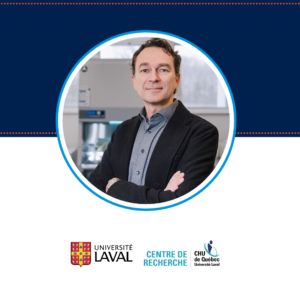
Marc-André Fortin, Eng., PhD, Full Professor, Department of Materials Engineering, Faculty of Science and Engineering, Université Laval; CHU de Québec–Université Laval Research Centre
Accelerating the generation of reliable scientific data in nanomedicine through an advanced microscopy service for Québec companies in the vaccine and pharmaceutical sectors.
The rapid development of nanomedicines, particularly in vaccinology, gene therapy, and targeted drug delivery, is creating a growing need for methods capable of accurately characterizing extremely small and fragile nanoparticles. Cryogenic transmission electron microscopy (cryo-TEM) enables high-resolution imaging while preserving their structure, but adapting this technology to industry needs remains challenging. It requires the rapid acquisition of large numbers of representative images and robust analysis of hundreds of nano-objects that may vary considerably in size, shape, and structure. This final step relies on advanced computational approaches, potentially including machine learning and artificial intelligence.
The project aims to develop an end-to-end cryo-TEM analysis workflow specifically tailored to nanomedicine products, from optimized sample preparation to image acquisition and quantitative analysis, notably through advanced computational approaches. The service will enable faster generation of robust scientific data on nanoparticle size, shape, and structure to support product development and regulatory characterization. Once developed, it will be accessible to Québec companies and academic research teams working in nanomedicine.
Partners
- Aramis Biotechnologies Inc.
- Feldan Therapeutics Inc.
- Sachiko Sato, Université Laval and CHU de Québec–Université Laval Research Centre
- Masahiko Sato, Université Laval and CHU de Québec–Université Laval Research Centre
This project is supported by the Government of Québec through Médicament Québec, which is investing $300,000. An additional $200,000 is being contributed by industry partners, bringing the total investment to $500,000.

Peter M. Siegel, Professor, Department of Medicine, McGill University; Goodman Cancer Institute
An Integrated ADC Development Platform Connecting Antibody Engineering, Critical Quality Attributes, and Translational Performance for Québec’s Biotechnology Ecosystem
Antibody-drug conjugates (ADCs) combine the ability of antibodies to target cancer cells with the potency of therapeutic agents. Despite their significant potential in oncology, ADC development remains complex, time-consuming, and costly, particularly because many of the characteristics that determine their efficacy, safety, and manufacturability are still evaluated through trial-and-error approaches relatively late in the development process.
The project aims to develop an integrated ADC design and development platform connecting computational modeling with analytical characterization, biological testing, and translational evaluation. By assessing critical attributes that influence ADC performance earlier in the development process, the platform will enable better selection and prioritization of promising candidates, reduce reliance on trial-and-error approaches, and accelerate their progression toward clinical development. Designed as a shared resource, the platform will bring together complementary expertise and infrastructure and will be accessible to researchers and biotechnology companies across Québec.
Partners
- 9Bio Therapeutics
- Pierre Thibault, Institute for Research in Immunology and Cancer (IRIC), Université de Montréal
- Frédéric Couture, TransBIOTech
This project is supported by the Government of Québec through Médicament Québec, which is investing $300,000. An additional $250,000 is being contributed by industry partners, bringing the total investment to $550,000.
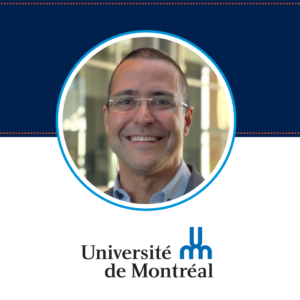
Grégoire Leclair, Full Professor, Faculty of Pharmacy, Université de Montréal
Toward Sustainable Pharmaceutical Self-Sufficiency: Structuring and Standardizing Pharmaceutical Compounding in Québec
Pharmaceutical compounding enables pharmacists to meet patients’ needs when commercially available medications are unavailable or unsuitable, particularly in pediatrics, rare diseases, or during drug shortages. However, broader use of compounded preparations remains limited by a lack of robust stability data, standardized methods, and harmonized practices.
The project aims to establish a province-wide framework for the validation, standardization, and implementation of compounded preparations. Eight stability studies will generate robust data and support the development of transferable methods to address priority needs in pediatrics, dermatology, and pain management. Validated formulations may then be incorporated into the Magistrales Standardisées au Québec (MSQ) repository to facilitate their adoption across the healthcare system. This new capability will help strengthen local supply chains and the resilience of Québec’s healthcare system, particularly during drug shortages.
Partners
- Medisca Pharmaceutique Inc.
- Gaëlle V. Roullin, Faculty of Pharmacy, Université de Montréal
- Mihaela Friciu, Faculty of Pharmacy, Université de Montréal
This project is supported by the Government of Québec through Médicament Québec, which is investing $300,000. An additional $160,000 is being contributed by industry partners, bringing the total investment to $460,000.
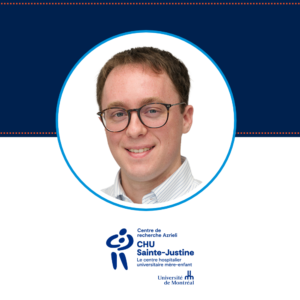
Marc-André Legault, PhD, Assistant Professor, Faculty of Pharmacy, Université de Montréal, and Researcher, Azrieli Research Centre, CHU Sainte-Justine
Artificial Intelligence to Optimize Clinical Trial Protocols and Study Design
The development of new drugs remains a lengthy, costly process with a high risk of failure. Among the many factors influencing the success of a clinical development program, trial design and operational feasibility play an important role. However, certain challenges encountered in practice can be difficult to anticipate when designing clinical trial protocols.
The project aims to develop artificial intelligence tools to optimize clinical trial design and identify operational risks earlier in the process. By combining detailed industry data from 13,700 clinical studies with Québec expertise in artificial intelligence and causal inference, the team will develop two complementary approaches: a tool capable of recommending protocol modifications to improve feasibility and the likelihood of operational success, and an agentic AI system designed to identify risks and propose mitigation strategies.
Developed and validated in collaboration with industry partners, these tools will be designed to address the practical needs of stakeholders involved in pharmaceutical development and could be integrated into clinical trial design and planning processes. The project will help strengthen Québec’s capabilities at the intersection of artificial intelligence and clinical development while fostering collaboration between academia and industry.
Partners
- Groupe Sorintellis
- Vantage BioTrials
- Prof. Audrey Durand, Department of Computer Science and Software Engineering, Université Laval
- Prof. Mireille Schnitzer, Faculty of Pharmacy, Université de Montréal
This project is supported by the Government of Québec through Médicament Québec, which is investing $300,000. An additional $700,000 is being contributed by industry partners, bringing the total investment to $1 million.
Comments are closed.